My Work
My passion for articulated library program development stems from a commitment to academic integrity and developing in students their confidence, critical thinking skills and preparation for deeper learning and civic involvement as they carve out opportunities for themselves. As a career educator who has worked across grade levels and disciplines, I have insight into the demands placed on teachers, students and administrators as we orchestrate learning experiences and a school culture of engagement. My "view from the helicopter" (looking across grade levels and disciplines while applying increasingly complex technologies) is very much helped by strong relationships and experiences with teachers and individual students-- that is, effective and continual work "in the trenches."
Seven years at H-B Woodlawn Secondary Program have given me a chance to support a One-to-One program and offer lessons and resources for skills development across 7 grade levels. The library's information literacy program at Thomas Jefferson High School for Science and Technology evolved across my five years there to integrate value-adding lessons at each grade level that articulate instruction necessary for advanced research in the 21st century. Teaching is my first love. It's never been more important than in an age of misinformation that a skilled teacher-librarian collaborate effectively to support research unit design and classroom instruction. I collaborate regularly with teachers to integrate library instruction with high quality, 21st century resources. I have also balanced in sponsorship of Future Problem Solvers (expanding its reach in Northern Virginia.)
My approach to curriculum development and lesson planning starts with assessment and works backwards (following the UbD model) to design articulated instruction that targets standards for growth. I am frequently and enthusiastically engaged with students and their projects to assess student learning.
Library Services at H-B Woodlawn
HBW's library will soon move to a new location; I've been involved in the facility design process. In addition to teaching grades 6-12, HBW serves adult learners of English, and I've worked to improve our collection's holdings (and outreach/collaboration with teachers) to satisfy and engage the interests of such readers.
Supporting Advanced Students at a STEM Magnet School

9th Grade IBET Boot Camp: a series of lessons integrated with teachers' assignments across students' ninth grade year, bringing our students (who come to us from 7 counties and diverse middle school experiences) to a baseline level of understanding of TJHSST library resources and skills for inquiry-based research.
Hum I: for their tenth grade year, students continue their articulated skills development with individualized projects of inquiry that develop from areas of personal interest.
TJ Citation Central: provided as a resource for developing respect for intellectual property, this site promotes the ethical use of information, as well as image sources for students' work and citation skills for scholarship.
Adopting and Implementing a K-12 Information Literacy Program
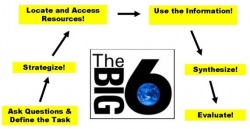
My article for Window Magazine describes the first two years of work at Taipei American School when the K-12 library faculty adopted the Big6 as the school's research process and worked to integrate skills instruction into the units the teachers had been working with for many years. I served as MS Teacher-Librarian there and was working to take those units further in the direction of Inquiry-based learning. I developed Google sites to publish those units online for parent information and access, and to reinforce use of the tools we were introducing as the school embarked on its 1:1 laptop program. Links to many of those units are provided below. My application of the Big6 is adapted from its creators Eisenberg and Berkowitz.
Questioning and Thinking Skills: Workshops, Lessons, Teaching Materials
I promoted regular engagement, reinforcement, and extension of the literacy building techniques and Habits of Mind in a student newspaper called The Dragon's Gazette that our library offered-- to which both students and parents subscribed online. See Sample 1, Sample 2. Our newspaper gave our students the opportunity to publish writing that shared their enthusiasm for favorite books in literature response letters, too. Likewise, the Literary Magazine that I sponsored at the elementary school of HKIS encouraged a culture of reading and writing.
Technology Mini-Lessons and Workshops for Teachers
Inquiry-Based Learning: Leader of Study Group

Guided Research using the Big6: Democracy and Role of Newspapers

I'm really proud of this project! It's an excellent example of collaborative work that was conducted over two years. As a social studies teacher who is very familiar with the standards, I was able to support our language arts/humanities teachers to develop a concept-based unit to help 8th graders get a good understanding of what government is. Students began with the introduction of vocabulary and concepts which I introduced with this Inspiration concept web. To emphasize the value of inquiry and free speech to democracy, we teachers and some students performed a skit that I located on "The Death of Socrates." To grab interest and bring comparative government concepts alive, I wrote scenarios that put our own teachers in starring roles as dictators, monarchs and democratic rulers. See humorous slide show. With the purpose of providing some experiential learning, students would "enjoy" the conditions of their classroom's democracy or dictatorship and write letters to the "citizens" in our other classrooms/states to learn what it was like to live there. (Thus, we were harnessing the middle schooler's social brain for writing and inquiring.) Students learned about the role the media plays in democracies vs. dictatorships (see slide show). And they applied the Big6 research process and information literacy skills to composing their own newspapers editorials and political cartoons.
Copyright, Citation, Safe Surfing, and Image use

The issues listed above have come into focus as our middle schoolers at TAS begin to apply their new laptops to blogging, making web sites, and posting original as well as copyrighted works. So I needed to research and "package" guidance for students and teachers that reflected the most recent interpretations of "fair use" for educational purposes, including emerging media. The web site that I built simplifies and shares "safe surfing" tools, information on Creative Commons, models for citation, and a decision-making flow chart and quickly gets students as young as 6th grade answers to the questions that arise as they create and share media. It helps educators find resources for learning about all of the topics in greater depth.
Information Literacy Skills Lessons: online videos

You'll hear my voice and sense how I use imagery to enhance my instruction in these instructional videos I created with Camtasia, PhotoStory and Studio 9. This is a favorite: Ebsco video. (View with windows media player.) These resources placed online allow students to re-visit lessons provided in the library. They also help parents understand the instructional support students are given to develop 21st century information literacy skills. Parents are important partners to us and to their children during research projects or book selection, so they appreciate being able to access information about the skills students are learning and the cyber-safe, high quality resources our school has purchased for their use. With the aid of these tools, parents can channel their support in ways that reinforce the school's instruction at the time of need.
Literature Circles: video, discussion models, and book guides

Here's a sample page of teaching resources that I compiled for teachers at our library's web site. Literature Circles provide students the interactive skills and a range of questions so that they can conduct for themselves dynamic and deep discussions about a book that a group has chosen to read. I produced this video for both students and teachers. (View with Windows Media Player.) It shows some of my students in action and can help teachers and students to understand what literature circles sound like and how to manage an effective discussion. It gives an overview of materials that help make Lit Circles work well. This handout is helpful for prompting good discussion questions and reflective behavior. As a support to teachers, I assembled links to resources such as question prompts, vocabulary lists and book summaries to enable them to launch multiple literature circle discussions at a time based on students' choice of novel and their reading ability. Note: although the home page is now updated, many of the other web pages from Hong Kong International School remain as I built them from 2004-2007, including the lessons menu and all of the teaching materials there.
The Kenbrena Webquest

Kenbrena is a project-based unit lasting 7-10 days that I adapted for the web. I introduced this learning activity to the 6th grade Humanities team and authored the pages for them. The purpose of the WebQuest is to introduce concepts in the social sciences in a way that children immediately see how they are practical in the world and why learning geography is relevant. View the video to see how students apply information about this fictitious continent in order to have a basis for dividing the continent into four viable countries.
Guided Research using the Big6: Current Events in Africa

To reinforce our use of the Big6 Research Process in 7th grade, I built this web site for our humanities teachers. It provides teachers a model of a new collaborative tool for us to use (Google Sites.) The site guides the students through the six steps of research and equips them with strategies, models and resources for an inquiry project exploring current events in Africa. For example, we provide instruction on using an online database, searching with Boolean Operators, and developing Works Cited lists with Noodlebib (an online bibliography builder.) Before launching the students on their independent projects, we modeled extensively and provided examination of historical background in this slide show that I composed and delivered.
Crusader Marketplace - unit incorporating the Big 6 Research Process

This example of collaboration with the 7th grade Humanities teachers shows my efforts to help move a long term research project off of worksheets and into web accessible format (as TAS transitions towards being a school in which all students have their own laptops.) See how I integrated the Big 6 Research Process into the project and supported it with links to my instructional videos. I believe that making this project web accessible helped us to reinforce our teaching objectives for students while providing them the resources they need to plan and pursue internet based projects. It is also enabled us to provide to our parents helpful communication of our curricular objectives.
Library's Web Page

As a library media specialist, I like to use the library's web pages (such as these, now maintained by TAS's new librarian) to provide to students, parents and teachers recommended reading lists and selected Web sites to support curricular units. I also housed there a large set of instructional videos to support the acquisition of information literacy skills. Here, you would find the WebQuests that I have authored, and support materials for events I've organized such as the Mock Presidential Election and Author visits. I use web pages to promote the library's subscription databases as cyber-safe materials. Having resources and online lessons easily available to our parents encourages strong partnership and clear communication of our curricular objectives. With such, parents can channel their energies productively in support of their child's learning.
Google Site: Big6 Research Project in Health Class

I constructed this web site to support our guidance counselor who wanted to assign a research project to her Health class. Since my collaborative efforts with teachers of grades 6-8 involves me in information literacy skills instruction, I was able to help our counselor design a project that asked student to apply skills that they have learned in previous assignments. Embedded in the site are my instructional videos and other links that students and the teacher can reference. These links were quite valuable support to us and to our researchers as we circulated among individuals to nudge them toward high quality resources, online models and their own greater achievement. Furthermore, this site enabled us to provide to our faculty another model of the Big6-- recently adopted for K-12 instruction. This site also provides our school with an exemplar for using Google Sites-- a tool that any teacher can use to easily author pages for the web.
Curriculum Development Model

I was a leader in developing and implementing a curriculum writing model at Hong Kong International School. It was highly effective in bringing stakeholders to the table to integrate information literacy, differentiation, and technology skills instruction in the coursework enjoyed by students in grades 3-5. Reviewing and revising 15 units in science and social studies each year enabled me the insight on teachers' objectives that served us to develop a well articulated program for students. The model and its benefits are described in the article that I co-wrote with my husband for ISTE's journal, Learning and Leading with Technology to be published in December, 2008.
Phi Delta Kappa - webmaster and trainer

I assisted our Taiwan Chapter of Phi Delta Kappa by volunteering to build its new web site and train its new webmaster.

